
WhatsApp has published specific terms for third-party agents connected through its third-party-agent platform. Those terms have a defined scope; they should not be casually treated as a rule that automatically describes every chatbot, API integration, or automation tool.
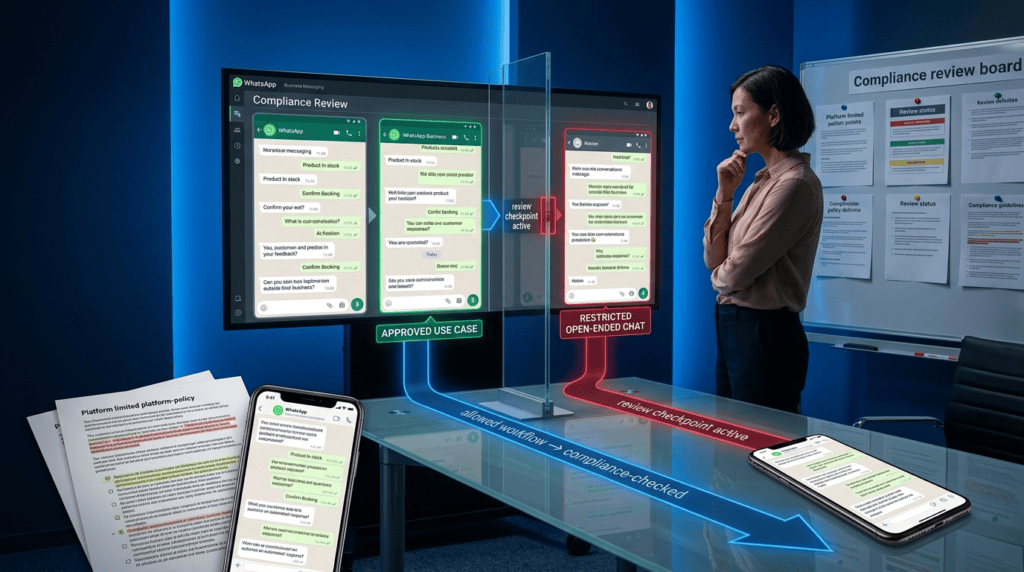
Identify the exact product and route
Determine whether the experience is a WhatsApp-provided third-party agent, a WhatsApp Business Platform integration, the Business app, or an unrelated third-party linking tool. Different products can have different terms. Read the terms linked to the actual service you intend to use.
Review data handling and user expectations
The third-party agent terms explain that providers are independent and responsible for their own outputs and data practices. For any AI tool, check what messages or profile data the provider receives, how long it retains them, whether outputs can be wrong, and how to stop using or disconnect the agent.
Identify which policy actually applies
First establish whether the tool uses the official WhatsApp Business Platform, WhatsApp's own third-party-agent connection, or an unofficial linked-device method. Those are not interchangeable, and a policy written for one route may not cover another. Then check the current terms, message rules, data obligations, user eligibility, and provider contract for that exact route. Do not state that all bots are approved or all AI chatbots are prohibited without direct evidence from the applicable policy.
Keep a policy scope note with each article
Record whether each statement applies to WhatsApp's own agent platform, the Business Platform, a Business app feature, or an external linked-device tool. Quote or summarize only the relevant rule and link to the official terms. Do not expand a narrow rule into a claim about every AI chatbot on WhatsApp. Where the product route is unknown, state that it must be verified before a definitive compliance conclusion can be made.
A related policy and safety question is covered in What to Do if a WhatsApp Number Is Banned; check the current official terms before applying either guide.
Before relying on this feature
- Name the exact service and connection method.
- Read the current applicable terms, not a headline or screenshot.
- Check provider access, retention, deletion rights, and complaint channels.
- Keep human review for consequential or sensitive answers.
Applying it to one task
A business evaluating an AI agent should map the message from the customer through WhatsApp, the agent provider, and any connected CRM. The map reveals what information leaves each system.
What not to assume
Do not claim that “all AI chatbots are banned” or that “all business bots are allowed.” The scope of a policy matters; ask a qualified adviser if the exact integration remains unclear.
Identify the exact terms that govern the agent
Use this mini-check on an authorized test setup before relying on this workflow. It is a repeatable test plan, not a claim that Erfan MD has already passed these cases.
- Determine whether the setup uses the WhatsApp Business Platform, a third-party agent, a linked-device method, or another integration; do not treat their terms as interchangeable.
- Read the current terms for that exact product and record the scope, permitted use, restrictions, and effective date.
- Test the required human-escalation path and confirm what data the agent can access before allowing it to handle real conversations.
A few common questions
Do the Third-Party Agent Terms cover every bot?
No. The official terms describe the specific third-party-agent platform and state their scope. Read the terms for the product in use.
Does WhatsApp endorse each third-party agent?
No. The official terms describe agents as independent third-party services.
Official guidance and references
- WhatsApp Terms for Use of Third-Party Agents
- WhatsApp Business Messaging Policy
- Meta Terms for WhatsApp Business
The relevant terms depend on the integration type. Compare the current Third-Party Agents Terms with the WhatsApp Business Platform terms instead of transferring a rule from one product to another.
- Rule-Based vs AI WhatsApp Bots: How to Choose — Compare fixed-rule and AI-assisted WhatsApp bots by predictability, language variation, cost, testing, and the need for human review.
- WhatsApp Bot Myths: Privacy, Safety and Spam — Separate common WhatsApp automation myths from documented limits around privacy, third-party tools, unsolicited messages, and account….